
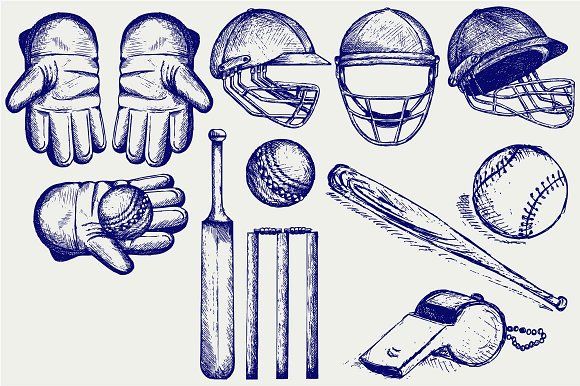
Cricket is a wildly popular game played on a circular field by 11 players per team. Players wear various protective equipment to protect themselves from the hard, red ball that can travel at high speeds.
Arm guards are a form of protection that is slipped on like gloves to shield the elbow. Leg pads extend from the knee down to the ankles and have thick padding to protect batters. A set costs about $20.
Bat
The bat is a distinctive piece of sports equipment in cricket that has a flat front and a wooden handle. It is typically made of willow wood and hardened through a process known as “knocking in.” To prepare the bat, it should be oiled with linseed oil to promote its elasticity and protect against cracking.
A cricket batter uses the bat to defend a wicket, which is comprised of 3 vertical stakes called stumps topped with 2 horizontal blocks of wood called bails. The goal of a bowler is to hit the bails, which will cause them to fall and end the batter’s turn. The batter can then decide to trade places with the non-striker and score a run or remain behind to continue batting.
One type of protective equipment that cricket players wear is leg guards, which are a type of spandex pants with foam or plastic shells that cover a player’s knees and shin bones to prevent them from being hit by the heavy, flying red ball. These are usually sold in pairs and cost $20 to $50 per pair.
Ball
There are a few important pieces of equipment needed to play cricket. These include a bat, a ball and wickets. The bat is a piece of wood with a handle on top to hold and hit the ball. The ball is a spherical object made out of cork and covered in leather. It is normally red in test matches and white for ODI and T20 games. The wickets are three wooden poles that are placed on the pitch with two bails sitting across them. Boundaries are ropes that define the field.
Drawing sports equipment can be challenging, but it is a great way to practice and improve your skills. To draw a cricket, start with a light pencil sketch and then use a dark color to add shadow and depth. Once you’ve added the details, use a light color to fill in the rest of the image. Try adding small tufts of hair to the antennae for extra realism. You can also experiment with different pencils and papers to find the look that you like best.
Stumps
Stumps are upright wooden poles that, along with two bails, form the wicket. They are a critical piece of equipment in cricket because the objective of the bowler when delivering the ball is to knock down these stakes and dismiss a batter from their turn. The stumps are bought in sets of three and are typically given a waterproof coating due to their outdoor use.
The sight screen is a crucial piece of equipment for batting because it allows players to see the flying red ball coming at them. It consists of a number of panels with slats separating them and is placed several yards out into the field behind both pairs of wickets.
Another essential safety piece of equipment in cricket is the jockstrap and cup combination. With balls being thrown at speeds upward of 80 mph, this type of protection is necessary for a batsman to avoid injury. Arm guards are also an important piece of protective equipment that protect a player’s arms from being hit by the hard cricket ball. These guards are slipped on like gloves and cover the player’s forearm.
Thigh Guards
A cricket player’s body needs a lot of protection to withstand the heavy ball thrown at high speeds. This is especially true for batters, who may be hit in the groin area by a stray ball. Cricket players use a variety of protective gear, including arm guards and leg pads. They also wear a jockstrap with a cup pocket into which a “box” or abdo guard is inserted to protect the crotch from the impact of a hard ball.
In drawing a cricket, start by sketching the basic shapes of the head and abdomen. The head should be a small circle with two curved lines for the antennae. The abdomen should be a series of long, thin rectangles. Next, draw the legs. The thigh guards are a pair of padded covers that extend from the batsman’s knee down to his or her ankles. They protect the batsman’s legs from bouncing balls or short-pitched ones that can cause severe injuries. These pads can also help prevent injuries from collisions with other players or the ground.
Rope Boundaries
A rope boundary defines the edge of a cricket field. A ball that hits the boundary earns four runs for the batting team. The boundary may be a fence or it may be a sideline fence with a white line.
This white line, known as the batting crease, is 1.2 meters from the stumps. A pair of carved small pieces of wood are attached to the stumps and these are called bails. A set of parallel lines is drawn on either end of the crease to form a boundary.
There are also two sight screens at the boundary, positioned at either end of the field. This boundary enables fielders to see where the ball will bounce or roll past the wicket.
A fenced boundary was once used, but the ICC now uses a rope boundary. This allows fielders to run at the ball without fear of injury. This has made the game much more exciting and entertaining for spectators. Also, the batting stance is more natural, because the fielder does not have to worry about being hit by the bat.
